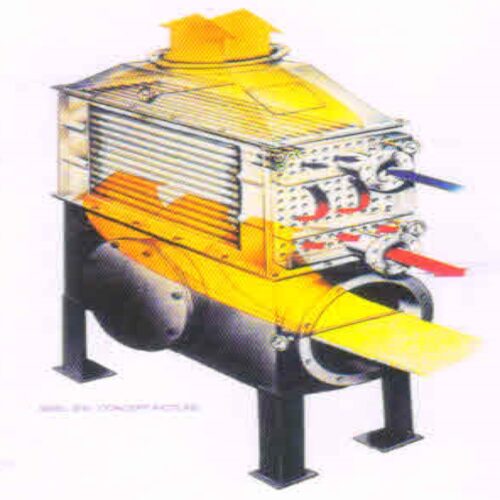
Introduction to RPC (Rotary/Rotatory Particulate Collector)
A Rotary Particulate Collector (RPC), also known as a Rotatory Particulate Collector, is an air pollution control device used to remove dust, smoke, and other solid particulate matter from industrial exhaust gases. It operates by combining the principles of centrifugal force and rotational motion to separate particles from the gas stream.
In an RPC, contaminated air enters a rotating chamber or collector where the spinning action creates a centrifugal force. Due to their greater mass, particulate particles move outward toward the collector walls, while the cleaner gas remains near the centre and exits through an outlet. The collected particles are then removed and disposed of or recycled.
RPCs are widely used in industries such as cement manufacturing, metal processing, power plants, and chemical production because they are relatively simple in design, have low maintenance requirements, and can handle large volumes of gas. Although they are highly effective for removing coarse and medium-sized particles, their efficiency decreases for very fine particulate matter compared with devices such as electrostatic precipitators or bag filters.
Advantages:
- Simple construction and operation
- Low maintenance cost
- Suitable for high-temperature gases
- Can handle large gas flow rates
Limitations:
- Lower efficiency for very fine particles
- Performance depends on rotational speed and particle size
Thus, the Rotary Particulate Collector serves as an important device for reducing industrial air pollution and improving environmental quality.
Nashik 10 MT Biomass boiler Before RPC installation
Nashik 10 MT Biomass boiler After RPC installation
Product & Services
- Carbon Trade Exchange
- Mechanical Vapor Recompression
- MSW-Based Biogas Plant
- Novel Green Energy Management
- Rotary/Rotatory Particulate Collector
- Electrostatic Precipitator
- Sugar Mill Lubricants LAAPSA
- Centralised Lubrication System
- Zero Liquid Discharge Solution
- Electronic Weighing & Bagging Machines